
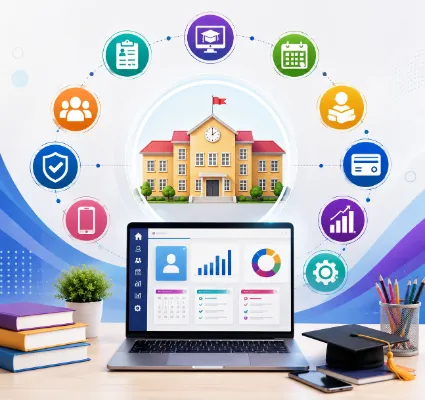
If you've ever sat through a school admin meeting where someone pulls out three different spreadsheets, a fee register, and a WhatsApp group just to answer one parent's question you already know why schools are moving to ERP software.
Admissions, attendance, fees, exams, transport, staff records, parent updates in most schools, these still live in separate systems that don't talk to each other. A good School ERP fixes that by putting everything on one platform, so your team stops copy-pasting data between tools and starts actually using it.
The tricky part is that India's School ERP market is crowded. Some platforms are built around academics, others lean into finance or communication, and a few try to do everything at once. What works for a 300-student school in a small town won't necessarily work for a 5,000-student campus with multiple branches.
This guide walks through 10 platforms worth putting on your shortlist for 2026 including OneFlawless along with a practical framework for actually choosing between them.
At its core, a School ERP is a single platform that runs your school's academic, administrative, financial, and communication work instead of scattering it across separate tools.
Rather than juggling an attendance register, a fee-collection app, an admissions spreadsheet, and a parent WhatsApp group, everything sits in one connected system that your staff, teachers, students, and parents can log into.
Depending on which platform you pick, you'll typically get some combination of:
Student information management
Online admissions
Attendance tracking
Fee management
Exams and results
Timetabling
Homework and assignments
Lesson planning
Parent communication
Staff management and HR/payroll
Library management
Transport management
Accounting
Inventory tracking
A mobile app
Dashboards and reports
Biometric, RFID, and GPS integration
Online payments
The point isn't just to digitize each task on its own, it's to connect them, so a change in one place (a fee payment, an attendance mark, an exam score) updates everywhere it needs to.
Running a school on manual processes gets harder every year you grow. More students means more spreadsheets, more registers, more phone calls, more room for something to slip through the cracks.
Sound familiar? Duplicate student records. Attendance that doesn't match the fee ledger. Admission forms sitting in a drawer. Parents called the front desk because they never got the circular. None of this is anyone's fault, it's just what happens when a growing school runs on disconnected tools.
Here's what changes when you bring in a proper School Management Software:
One student profile, not five: Academic history, attendance, fees, exam results, and parent details all live under a single record instead of scattered across different systems.
Attendance that takes seconds, not minutes: Digital attendance with biometric or RFID options if you want them cuts down the paperwork and gives admins real-time visibility.
Fees that don't need a calculator: Structures, installments, concessions, receipts, reminders, and outstanding-payment reports, all handled digitally.
Parents who actually stay informed: Notifications for attendance, homework, fees, and events go out automatically instead of relying on a note stuffed in a school bag.
Faster academic admin: Lesson plans, assignments, marks, and report cards get managed digitally instead of by hand.
A clearer picture for leadership: Dashboards give management real visibility into admissions, attendance, fees, and academic performance without waiting for someone to compile a report.
Here's the shortlist OneFlawless plus nine other established players worth comparing.
OneFlawless is built to bring the academic, administrative, financial, and communication sides of running a school into one connected system — rather than making you stitch together five different tools.
If you're hunting for the best School ERP software in India, We cover a lot of ground: admissions, student records, attendance, exams, fees, transport, staff management, academics, HR and payroll, library management, lesson planning, assignments, accounting, and employee management.
What's included:
Admission and student management
Attendance tracking
Examination management
Fee management
Transport management
Staff management and academics
HR and payroll
Library management
Lesson planning and assignments
Financial accounting and employee management
Dashboards and reports
Biometric, RFID, and GPS integration
Online payments
A mobile app and built-in communication tools
The mobile app is where a lot of the day-to-day value shows up parents, students, teachers, and admins can check notifications, calendars, circulars, attendance, leave requests, fees, homework, library status, transport, exam results, timetables, and the syllabus, all from one place.
Why it's worth a look: the real benefit of an integrated platform isn't any single feature, it's not having to manage five logins and five vendors just to run one school. Whether you need biometric attendance, GPS-tracked buses, or full HR and payroll, it's worth seeing how we handle your specific mix of requirements in a demo.
Best for: schools that want one connected system covering academics, admin, finance, and communication, rather than a patchwork of point solutions.
A long-standing name in Indian school management, CampusCare covers student information, attendance, fees, exams, communication, transport, and general administration.
Key features: student info management, admissions, attendance, fee management, exam management, report cards, parent communication, transport, staff management, academics, mobile access.
Best for: medium to large schools that want broad, established administration coverage.
Fedena is one of the more widely known education management platforms, with a modular structure that spans student management, academics, exams, fees, and integrations.
Key features: student information system, admissions, attendance, exams and grading, fee management, timetabling, student/parent portals, communication, library management, HR functionality, mobile apps, integrations.
Best for: institutions that want a configurable platform they can build on as they grow.
MyClassCampus connects students, parents, teachers, and admins through a single environment, with a focus on the everyday tasks schools handle most: attendance, fees, exams, homework, and communication.
Key features: student management, attendance, fee management, exam management, homework, parent communication, mobile app, transport management, reports, admin tools.
Best for: small to medium schools looking for centralized, no-frills management.
Teachmint leans harder into digital teaching and classroom tools than most on this list, which makes sense given its roots in edtech rather than pure administration.
Key features: digital classroom tools, online teaching, attendance, homework, assessments, student management, parent communication, learning resources, mobile access, admin capabilities.
Best for: schools that want digital classrooms and learning tools alongside basic school management.
Edunext offers a fairly wide net of modules: admissions, student management, attendance, fees, exams, academics, communication, transport, and administration.
Key features: admissions, student info, attendance, fee management, exam management, report cards, homework, parent communication, timetable, transport, library, HR and payroll, inventory management, mobile apps.
Best for: schools that want extensive functionality when comparing education ERP software options.
MyClassBoard is built for day-to-day academic and administrative operations, with the usual mix of student, attendance, fee, and exam management.
Key features: student information, admissions, attendance, fee management, exam management, parent communication, transport, staff management, academics, reports, mobile access.
Best for: K-12 schools that want centralized management without unnecessary complexity.
Campus 365 connects the core academic and administrative processes, with some RFID-related capabilities built in.
Key features: online admissions, student management, attendance, exam management, fee management, parent communication, timetabling, library management, mobile access, RFID capabilities, reporting, dashboards.
Best for: small and medium schools that want integrated management without a huge feature list to wade through.
SchoolKnot is a cloud-based platform built around day-to-day school administration and parent communication.
Key features: online admissions, student management, attendance, fee management, homework, exam management, parent communication, transport management, reports, mobile access.
Best for: schools that mainly want solid essentials plus good communication tools.
Campus 24x7 focuses on digital administration built specifically around Indian school workflows.
Key features: admission management, student management, attendance, fee management, exam management, academic management, HR management, communication, mobile access, reports and dashboards.
Best for: Indian schools wanting an integrated, cloud-based platform.
It's tempting to compare ERPs by counting how many modules each one has. Don't. A platform with 30 modules you'll never touch is worse than one with 12 you'll use every single day. Here's what actually matters:
Student management - one profile per student holding academics, attendance, fees, exam results, and documents, not five different records that need reconciling.
Admissions - online enquiries, applications, document uploads, verification, and enrollment, without a printed form in sight.
Attendance - fast for teachers to mark, easy for admins to monitor. Worth checking for biometric or RFID integration, staff attendance, leave management, and automated alerts if those matter to you.
Fees - structures, installments, concessions, discounts, online payments, receipts, outstanding-payment tracking, reminders, and financial reporting.
Examinations - scheduling, marks entry, grading, remarks, result processing, and report cards that match how your school actually runs exams (not a generic template).
Parent communication - notifications, circulars, SMS, email, and app alerts for attendance, homework, and fees.
Mobile app - this is the piece parents and students will judge you on. A school mobile app should let people actually do things, check attendance, pay fees, view homework, not just read a static notice board.
Transport - routes, stops, drivers, GPS tracking, and reporting, if your school runs buses.
HR and payroll - employee records, attendance, leave, and salary processing for your staff, not just your students.
Dashboards and reports - a real-time view of attendance, fees, admissions, exam performance, and staffing, so leadership isn't waiting on someone to compile a report by hand.
RFID and biometric attendance can genuinely cut down manual work but they're not automatically worth adding just because a vendor offers them.
An RFID school management system can track student movement or attendance depending on how it's implemented, and biometric systems can automate staff or student check-ins. Before you commit, though, think through the actual use case, whether your existing hardware is compatible, and how the vendor handles the data these systems collect.
Indian schools are only going to lean further into connected, data-driven administration from here. The 10 platforms covered in this guide OneFlawless, Entab CampusCare, Fedena, MyClassCampus, Teachmint, Edunext, MyClassBoard, Campus 365, SchoolKnot, and Campus 24x7 each take a slightly different approach to solving the same underlying problem.
But the "best" ERP isn't the one with the longest feature list or the biggest logo wall of clients. It's the one that fits how your school actually works.
Before you decide, weigh:
Ease of use
The modules you actually need
Mobile app quality
Integrations
Data security
Scalability
Implementation effort
Support quality
Total cost not just the quote
Whether your staff will actually use it
And whatever you do don't skip the live demo. Test real workflows with real staff before you sign anything.
If you're evaluating education ERP software for 2026, OneFlawless is worth including in that process alongside the other established platforms above.
1. What is the best School ERP software in India?
There's no universal answer; it depends on your school's size, budget, board, student count, required modules, integrations, and support needs. Compare a few platforms and actually test their workflows before deciding.
2. What features should a School ERP include?
At minimum: student management, admissions, attendance, fees, exams, report cards, timetabling, homework, lesson planning, parent communication, staff management, HR and payroll, transport, library, accounting, reporting, mobile access, and integrations.
3. How much does School ERP software cost in India?
It varies based on student count, modules, branches, customization, implementation, integrations, and support. Always ask for a full quotation covering both setup and recurring costs.
4. Is School ERP software worth it for small schools?
Yes — small schools benefit from student management, admissions, attendance, fees, exams, and parent communication just as much as larger ones. Just make sure you pick a solution with essential features, simple usability, and pricing that scales with you.
5. Can School ERP integrate with RFID, biometric, GPS, and payment systems?
Most modern platforms support these integrations, but availability and compatibility vary by vendor confirming this before implementation, not after.
6. How do I actually choose the right School ERP?
Start with your school's real pain points, list your must-have features, shortlist a few vendors, sit through live demos, test the mobile app with real teachers and parents, check integrations and security, get the full cost breakdown, and evaluate support before making a final call.